
Law firms are now being targeted through their people and their premises as well as their systems, by criminal groups, hostile states, activists and individuals with a grievance against a lawyer or a client. Each of those potential weak points is often the responsibility of a different person or team within the firm, and the gaps between them are where attacks increasingly succeed.
Why law firms are targeted
Law firms hold information on clients that is often exceptionally valuable to attackers. Lawyers are highly valued and exceptionally trusted advisers on the most sensitive corporate and personal matters. They see strategic developments and potential transactions before the market does, develop litigation strategies, and see regulatory investigations before they become public. Lawyers working for the very wealthy see the private affairs of families who go to considerable lengths to keep their affairs private.
Law firms have relatively simple systems but growing dependence on technology tools and, all too often limited cyber-security budgets, especially in mid and smaller size firms. So attackers often see law firms as an easier route to sensitive information than targeting corporate systems, individual executives or wealthy clients. Partners are listed on firms’ websites with their practice areas, offices are open to visitors, and staff are expected to help anyone who appears to be a client or a colleague.
Those who want what a firm holds include organised criminals seeking ransoms, extortion opportunities or fraud, and hostile states seeking intelligence on politically exposed individuals, deals and disputes. They also include activists targeting some of the clients firms act for and individuals with a grievance against a lawyer or a judgment. Cyber-attack is the most frequent means of capturing sensitive information, with technical attacks often enabled by, or combined with, physical and human approaches.
Where we look first
How we begin an assessment of a firm’s people, premises and information systems.
The attacker’s view
We start with the threat to each office and with what is already public about the firm, its clientele and its people, from the website and professional directories to company filings and social media. This helps us understand why a targeted attack might be made and where it is most likely to come from.
Are technical defences appropriate?
We meet with IT management and security teams to review technical defences against information loss from firm’s systems. We discuss customary practices of working lawyers, how security arrangements may weaken when staff travel or work from home; and review how the firm is responding to new risks as a result of the growing use and capability of AI.
The people approached first
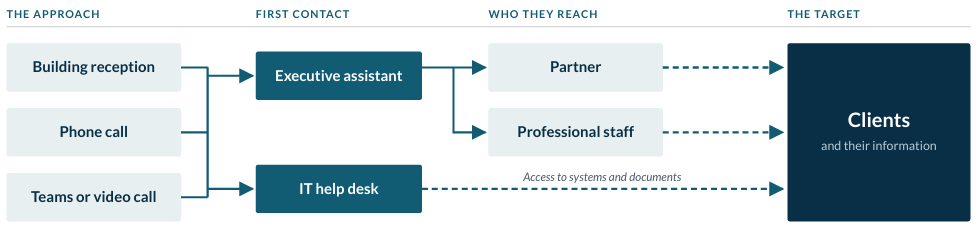
We walk each office from the street to the meeting rooms, professional offices and other spaces. We speak to the people who run it day to day. Receptionists, executive assistants and the help desk get particular attention, because they are the first people a caller posing as IT or a visitor with a plausible story will try.
The management of insider related risks
We discuss with senior management how the firm manages potential insider risks, including the risks of well-intentioned staff inappropriately responding to someone posing as a client, and of privileged staff at IT service providers being compromised.
How the office would respond
We take the physical threat scenarios a firm is most likely to face and walk them through with each office, to see who is likely to notice, who would be told and whether existing plans are likely to work. The answer decides what needs to change, and in some offices, it will be very little.
How joined up are security arrangements?
We then review how physical, human and cyber security arrangements work together. We look for potential opportunities for technical controls over systems to be defeated by an intruder, for physical security controls to be defeated by cyber attack; and for other potential points of combined security vulnerability.
How security threats against law firms unfold
The call that becomes a visit
The Federal Bureau of Investigation (FBI) has warned that a criminal group known as Silent Ransom Group has targeted US law firms consistently since spring 2023. Its members call staff while posing as the firm’s information technology (IT) support, persuade them to open a remote session, and then steal data and threaten to publish it. The group also calls other employees and the firm’s clients to add pressure. In May 2026 the FBI reported a further step. Should the call fail, the group sends a person to the office posing as an IT engineer, following up the call the employee has already received. The visitor says the computer needs to be backed up because of the earlier problem, then plugs in a storage device and copies the data. The FBI has not said how these visitors got past reception, but the first of its recommendations is to check the identity of everyone entering the premises.
Material said to come from the group, leaked in October 2026 and partly corroborated by blockchain analysts, adds detail. Analysis of the leak found that 42 of the group’s 50 most recently observed victims were law firms, that its members compile lists of senior people from commercial databases of people’s details, and that callers are coached to manage staff who are suspicious or resistant. The leak also suggests the group recruited people for the office visits through adverts for casual paid work, in one case as nightclub promotion, although analysts found much weaker evidence that the visits succeeded. Either way, the attack relies on an assistant, a help desk and a receptionist each doing what seems reasonable at the time, with nobody connecting one approach to the next.
The reader you never see
Hostile states and the groups working for them pursue law firms for what they know about transactions, disputes and government policy. In October 2025 a prominent Washington firm confirmed that lawyers’ email accounts had been accessed by an actor it believed to be working for a foreign state, using a previously unknown software flaw. Reporting at the time linked the intrusion to a wider campaign against US law firms attributed to China. Intrusions of this kind are designed to stay quiet for months and may only come to light when a client or a government agency raises them. In the UK, MI5 reported a 35% rise in state threat investigations in the year to October 2025.
The person inside
Access to deal and client information is part of a lawyer’s job, which makes its misuse hard to spot. In May 2026 US prosecutors charged 30 people over an alleged scheme running for ten years in which lawyers at major firms passed on confidential information about nearly 30 mergers and acquisitions, much of it allegedly viewed through the firms’ own document management systems. Criminal groups also recruit insiders directly, and in 2025 a ransomware group offered a BBC journalist a share of any ransom in return for access to the corporation’s systems. The warning signs of an insider are usually spread across human resources (HR), IT and the practice group, where no single person sees all of them.
The threat to the person
Alongside these, the risk to individual lawyers has grown. In a Law Society survey published in November 2025, almost half of solicitors said they or their firm had received a threat in the previous year, and 38% felt their personal safety was at risk because of their profession, rising to 68% among criminal lawyers. During the riots across England that followed the Southport murders in summer 2024, lists naming immigration advice centres, law firms and individual solicitors circulated online as potential targets. In 2020 a man walked into a law firm in Harrow with a knife, intending to kill a solicitor because the firm helped immigrants, and was disarmed by the receptionist. In December 2024 he was given an indefinite hospital order. Firms that act for contentious clients also face protest at their door, and in December 2024 activists occupied the lobby of a leading firm’s London office and sprayed the building with fake oil.
Security risks for international and private client law firms
International and City firms
Firms with offices in several jurisdictions carry risks that differ sharply from one office to the next. After Iranian strikes on Gulf states at the start of March 2026, international firms moved staff in the region to remote working at short notice and activated their security plans. In China, the 2023 counter-espionage law allows exit bans on anyone under investigation, and a due diligence firm’s Beijing office was raided that year, showing how quickly advisory work can be treated as a security matter.
Clients are also testing their advisers more closely. The Association of Corporate Counsel’s model requirements for outside counsel cover physical security and staff background screening as well as cyber controls, and many legal departments audit firms against requirements of this kind before instructing them.
Private client firms
A private client firm holds what amounts to a profile of each family it serves, covering home addresses, assets, trust structures, travel and often the names and schools of children. That file is valuable to criminals because it removes the need to watch a target. Kidnap and violent extortion to force the transfer of crypto assets is now concentrated in Europe, which accounted for 82% of verified incidents in early 2026, and more than half of French cases involved a member of the target’s family.
In July 2025 two crypto investors were held for 52 hours in east London and subjected to what the prosecutor called “cold, hard torture”, in a case where their lifestyles on social media may have drawn the gang’s attention.
The same families face a parallel cyber threat. A 2026 survey for Ocorian found that 43% of family offices had suffered a cyber-attack in the past two years and that 22% had no plan to respond to one, while payment diversion fraud cost buyers in property transactions £11.7 million in 2024/25. For these firms the test is whether their own security matches the sensitivity of what they hold about their clients.
Why the organisation of law firms makes this hard
Most firms divide these risks between people who rarely sit together. Typically a chief operating officer and facilities team owns the building, receptionists and support services; a chief information officer or IT manager owns the systems, the general counsel and risk team own reputational and regulatory exposures, HR owns professional and support staff management processes; and partners own client relationships and the day-to-day management of professional staff.
Typically each group manages with considerable autonomy while attackers look for opportunities to exploit information and process gaps between them targeting the natural desire to respond to any request from a client or person supporting fee-earning activity. Attackers have learned how to engage and deceive the reception desk, or executive assistants taking calls using increasingly sophisticated, AI-enabled, social engineering to take advantage of their client-service orientation.
Partners’ home addresses on public registers have been used to target them at home, exploiting home Wi-Fi networks as a route into a firm’s systems, then exploiting document systems that every fee earner can search.
Each team manages the risks they see directly. Sophisticated attackers look to exploit the gaps between teams.
Questions leadership should be able to answer
- Do we understand the security threats we now face as a result of our clientele, practices and geographical presence?
- If someone called an assistant tomorrow claiming to be from IT, or arrived at reception with an ID card and some knowledge of our systems, would our staff check who they were before letting them in?
- Who in the firm owns potential cyber, physical and other threats to partners, at the office, at home and when travelling?
- Would we notice a member of professional or support staff getting access to deal or client files that they have not been engaged on before a client or a regulator told us?
- When did leadership last rehearse an incident that combined a cyber attack, a physical threat and press attention?
- If a client or a regulator asked us to show what we have done and why, could we produce a record that would stand up to scrutiny?
Building a proportionate law firm security strategy
Understand the threat fully
They begin with a single assessment of the threat across people, premises and information, office by office, so that leadership can see where the exposure sits and decide which risks to accept and which to treat. In some offices the answer will be that current arrangements are sufficient, and that should be said plainly.
Clear leadership ownership and governance
A senior leader owns security across the firm and each action has a named owner. Leadership keeps a dated record of what it assessed, what it decided and why, written on the assumption that a client, an insurer or a regulator may one day read it.
One policy and standard across the firm
Security is set out in a single policy and standard that cuts across facilities, IT, HR and the practice groups, and is applied in proportion with a plan for each office. The people most likely to be approached, at reception, among the executive assistants and on the help desk, are trained to recognise an approach, to check any unexpected IT request by calling back on a known number, and to know who to tell.
Incident plans that are rehearsed
The firm has plans for incidents that combine a cyber attack, a physical threat and press attention, and leadership rehearses them regularly, including how it would respond if attackers contacted its clients directly.
About GSA Global
GSA Global is a security and risk firm based in the UK, with global reach. Our leadership has spent its careers advising and protecting businesses, people and information where the consequences of failure are serious. That includes leading national counter-terrorism and the protection of the Royal Family and the Prime Minister, running anti-corruption and intelligence work at Scotland Yard, leading UK Border Force and the Army’s counter-intelligence function, advising boards of global leading businesses and responding to some of the most serious cyber incidents in the UK.
We bring that experience to law firms as one team with deep insight and expertise in managing people-related, physical and cyber risks. We work alongside a firm’s own leadership, general counsel, operations and technology teams, and we make sure our advice reflects the culture, client relationships and market positioning of our clients. We give leadership a clear view of the security risks the firm faces and a proportionate plan to address them. We are independent of the companies that supply security solutions and services, so our recommendations are shaped only by what the firm needs.